
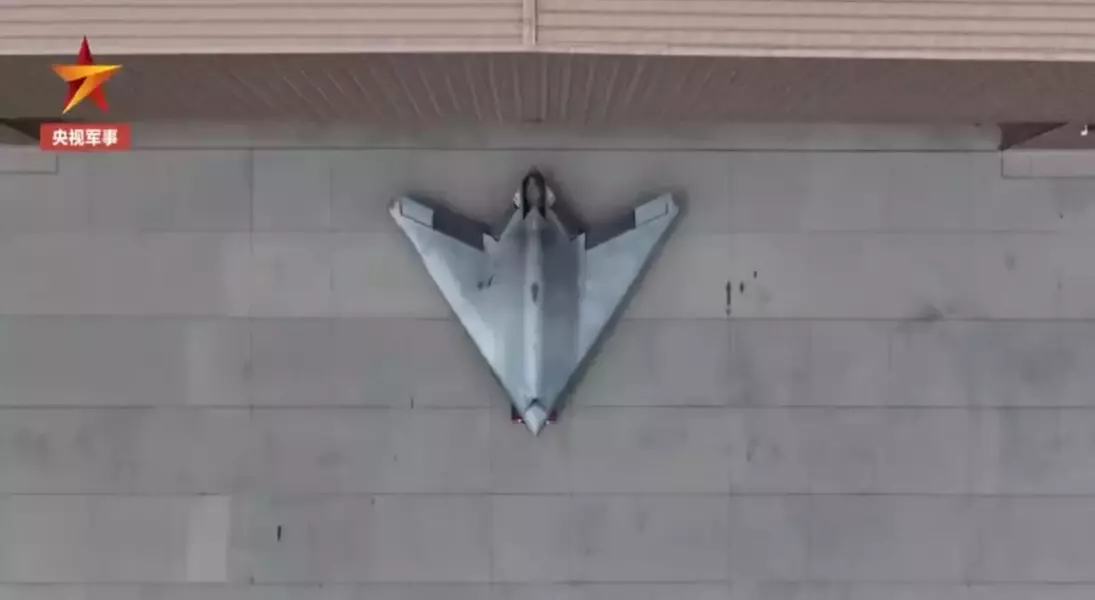
Recent television broadcasts from China have provided an unprecedented look into the GJ-11 stealth combat drone, revealing significant details about its design and intended operational roles. The newly released footage showcases the drone's dual internal weapons compartments, meticulously designed with serrated doors to maintain stealth, capable of housing air-to-ground munitions ranging from 1,000 to 2,000 pounds. Key features also include a sophisticated retractable twin-wheel nose landing gear and a trapezoidal sensor housing beneath the nose, likely for electro-optical and infrared targeting, akin to those found on China's advanced J-20 and J-35 fighters. The aircraft's flattened exhaust outlet, integrated into its upper fuselage, and its engine intake placement are strategic design choices aimed at minimizing radar and infrared signatures.
The GJ-11 is primarily designated for precision airstrikes and Suppression of Enemy Air Defenses (SEAD) missions, leveraging its stealth profile to penetrate hostile airspace. Strategic planning scenarios depicted in the footage illustrate the GJ-11's integration with crewed J-16 multirole fighters and J-20 fifth-generation stealth aircraft, indicating a collaborative approach to aerial combat, where the drone could undertake reconnaissance or weapon delivery roles. This development underscores China's commitment to advancing its uncrewed aerial vehicle capabilities, with the GJ-11 sharing design similarities with the U.S. Northrop Grumman X-47B, although the American counterpart never reached active service.
Details Emerge on China's GJ-11 Stealth Combat Drone
China has publicly unveiled extensive television footage of its GJ-11 stealth combat drone, offering an unprecedented glimpse into its structural intricacies and operational capabilities. This broadcast has brought to light previously unseen aspects of the aircraft, including its sophisticated internal weapons bays, advanced landing gear system, precise nose-mounted sensors, and a uniquely designed exhaust configuration, signaling a significant leap in China's uncrewed aerial vehicle technology.
The newly disclosed visuals confirm the GJ-11 features two internal weapons compartments, strategically positioned beneath its fuselage. Each bay is safeguarded by independently operated doors characterized by serrated edges, a design choice critical for maintaining the drone's stealth profile. While the precise dimensions of these compartments remain undisclosed, visual analysis from the footage suggests they are engineered to accommodate munitions weighing between 1,000 and 2,000 pounds. Chinese state media reports indicate these bays are versatile, capable of deploying various air-to-ground and surface-attack munitions. The internal carriage system is pivotal, allowing the aircraft to transport weaponry without external attachments that would compromise its aerodynamic performance or increase its radar signature.
Further details revealed include the drone's retractable landing gear, which smoothly tucks away after takeoff. This system features a substantial twin-wheel nose assembly, indicating robust design for ground operations. A trapezoidal installation prominently positioned beneath the drone's nose appears to house advanced electro-optical and infrared sensors, vital for reconnaissance, targeting, and observational missions. Similar sensor configurations are observed on China's J-20 and J-35 fighter jets, though the specific capabilities of the GJ-11's equipment are yet to be fully disclosed.
At the aircraft's rear, a flattened exhaust outlet is seamlessly integrated into the upper fuselage, with the engine intake cleverly situated above the main airframe. These design elements are crucial for reducing both radar and infrared signatures, complementing the drone's tailless flying-wing configuration and its internal weapons carriage, all contributing to its overall stealth performance.
The GJ-11 is specifically designed for critical missions such as precision airstrikes and Suppression of Enemy Air Defenses (SEAD). SEAD operations demand aircraft capable of locating, disrupting, or neutralizing hostile radar installations and missile systems that protect defended airspace. The drone's stealth design and internal weapons capacity position it as an ideal platform to approach these defenses covertly and execute precision attacks.
Compelling footage also depicted mission planning scenarios where GJ-11 aircraft were shown operating in conjunction with J-16 multirole fighters and J-20 fifth-generation stealth aircraft. This suggests a strategic intent by China to deploy the uncrewed platform alongside crewed aircraft, integrating it into complex combat roles such as reconnaissance, advanced weapons delivery, and other critical battlefield responsibilities. However, the exact mechanisms for sharing targeting information between these diverse aircraft, or the extent of the GJ-11's autonomous capabilities, were not detailed in the broadcast.
The lineage of the GJ-11 can be traced back to the experimental Sharp Sword demonstrator, with the drone first making a public appearance during China's October 2019 military parade. Subsequent satellite imagery has documented repeated testing activities at Malan in Xinjiang, and three units were reportedly observed at Shigatse in Tibet between August and September 2025. Noteworthy is the GJ-11's striking resemblance to Northrop Grumman's X-47B in its flying-wing shape, stealth design principles, and internal weapons compartments, although the American counterpart never transitioned into active military service or operational combat.
The public unveiling of the GJ-11 drone marks a significant milestone in China's military technological advancement, showcasing a sophisticated capability in stealth unmanned combat aerial vehicles. This development not only highlights China's growing prowess in defense innovation but also signals a potential shift in future aerial combat strategies, emphasizing integrated operations between crewed and uncrewed platforms. From a broader perspective, the GJ-11's emergence intensifies the ongoing global race in military drone technology, compelling other nations to re-evaluate and accelerate their own defense programs to maintain strategic parity.